One of my goals (and one of the reasons why I haven't been blogging much) is to learn 中文 (Chinese) as well as I can while I'm here in Taiwan. My friend Amy and I are taking a 中文 class at a university in Taichung. It's only two hours, once a week, but is it sooo much fun and definitely one of the highlights of our week. I get pretty giddy in class. I just love learning languages. It makes me so happy. 中文 is
so much fun to learn. The sounds are so different! I love learning the tones. It makes me so happy to study a language that's so drastically different from the languages I've learned in the past. It's a challenge I thoroughly enjoy.
Amy and I decided to learn ㄅㄆㄇㄈ (bu pu mu fu), the phonetic transcription system they use here in Taiwan. There are 37 symbols. This is what they look like: ㄅㄆㄇㄈㄉㄊㄋㄌㄍㄎㄏㄐㄑㄒㄓㄔㄕㄖㄗㄘㄙㄨㄩㄚㄛㄜㄝㄞㄟㄠㄡㄢㄣㄤㄥㄦ. See, in Chinese, one or two characters represents what we would call a word. (Each character represents one syllable, by the way.) So 樹 means "tree," and 老鼠 means "mouse." But there is a problem. When a native Chinese speaker sees a character for the first time, nothing about the character indicates the sound it represents. He or she has to learn what that sound is, and then memorize that that sound is associated with that character. It is nothing like the English alphabet, where we see a new word, and we have an idea of how to pronounce it.
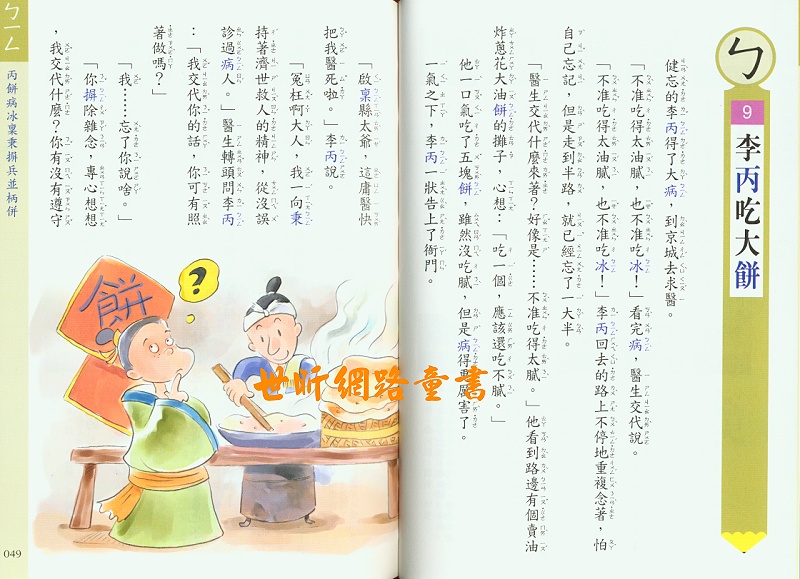
So the Taiwanese use this phonetic system they call bu pu mu fu in order to teach children to read. For example. The word "lion" is written 獅子. When a child sees these characters for the first time, they have absolutely no idea what they mean or how to pronounce them. That's where bu pu mu fu comes in.
Each character can be transcribed into one to three bu pu mu fu symbols, accompanied by a tone. (A tone is a
musical pitch or movement in pitch serving to distinguish two words otherwise composed of the same sound.) The second tone is indicated by this symbol: ˊ, the third tone by ˇ, the fourth by ˋ, and the fifth by ˙. If no tone is indicated, you know it's first tone. For example, in Mandarin Chinese, the sound "ba" can be pronounced five different ways, and each tone gives that sound a different meaning. Pronunciation is probably the trickiest part of speaking Chinese. The grammar's really not that bad.
Back to the word lion (獅子). In a child's book, to the right of 獅 is this symbol: ㄕ (and there's no tone indicated, so it's first tone). Thus the child (who has learned bu pu mu fu) knows what sound to make. And next to the character 子 is this bu pu mu fu symbol: ㄗ˙ (fifth tone). So, knowing bu pu mu fu, the child can now pronounce 獅子. After much repetition, a child will memorize the sound associated with the characters 獅子, and will be able to read them without glancing at the bu pu mu fu symbols alongside it. Cool, huh? That's how kids here learn to read.
In first grade, all characters in children's textbooks are accompanied by the bu pu mu fu symbols, as they're just learning to read. But by fourth grade, the characters in textbooks only contain bu pu mu fu symbols in the section where new characters are introduced.
The Taiwanese also type using bu pu mu fu. So if my Taiwanese friend wants to type the character for tree (樹), they have to type the bu pu mu fu associated with it: ㄕㄨˋ. Then any number of characters associated with that sound will appear, and they select the one they're looking for. In Taiwanese dictionaries, you will see bu pu mu fu symbols next to each character, indicating pronunciation.
Amy and I decided that this is the best way for us to learn to pronounce words correctly. You may have heard of pinyin, or the romanization system for Mandarin Chinese. Pinyin does help to a certain extent. But the letters in the roman alphabet cannot accurately represent the sounds of Mandarin Chinese. So though a little more effort is required to learn ㄅㄆㄇㄈ (bu pu mu fu), in the long run, I believe it will help me speak with more accurate pronunciation. I'm working on reading and writing it. I know I sound like a six-year-old when I read right now, but that's okay. (My students get a kick out of the fact the fact that they are so much better at something than their teacher.) It's a very satisfying feeling to look at a page full of traditional Chinese characters and the ㄅㄆㄇㄈ symbols and have it not be complete jibberish. It's a game to me: how much can I understand? It's a game I want to get better and better at. :)
You can read more about ㄅㄆㄇㄈ
here.
(By the way, this all works differently in China. They use pinyin, which seems bizarre to me.)
 Wesley Lin, one of my adorable second graders.
 A child's storybook.
 This is one of my student's Chinese homework. He's in
 Long time, no post, huh? I feel like I've been too busy living life to blog about it! But I need to get caught up. And I will!


